
A holiday dessert table feels more welcoming when its centerpiece is familiar, warmly spiced, and easy to share. I know how much comfort a dependable dessert can bring when guests are gathered and the kitchen is busy. A good pumpkin pie recipe should feel doable, even if you are baking between other holiday tasks.
I lean on simple steps and cozy spices, then choose a version that fits the time and ingredients I have. Custard is an egg-thickened mixture that sets as it bakes. Serve the finished pie at room temperature, with whipped cream if you like, and plan ahead for the days you will keep leftovers.
Key Takeaways
- Choose a filling formula made for its type of milk.
- Use pumpkin puree, not pumpkin pie filling, unless the recipe calls for it.
- Follow the crust method written for your chosen version.
- Check for a slight center wobble instead of baking until firm.
- Cool the pie fully before covering and chilling it.
I’ll help you match the recipe to your baking style, pantry, and schedule. Start with this quick guide to picking one.
Which Pumpkin Pie Recipe Should I Bake?
For the most familiar flavor, start with the traditional evaporated-milk version. It pairs pumpkin with cinnamon, ginger, cloves, and sugar for the classic holiday taste many guests expect.
Choose a filling based on the flavor and effort you want, because each formula balances its milk and sweetness differently. The caramel-pecan topping changes the served slice, not the filling itself, so it remains a variation on the classic base.
Choose a filling based on the flavor and effort you want, because each formula balances its milk and sweetness differently.
- Traditional evaporated-milk pumpkin pie suits anyone who wants the familiar flavor and a tested pantry-style formula.
- Brown-sugar pie with cream gives the filling a richer, silkier feel and a deeper taste.
- The five-ingredient sweetened-condensed-milk pie is a good pick when fewer ingredients and quick mixing matter most.
- A fresh-pumpkin adaptation starts with whole sugar pie pumpkins for bakers who want to prepare their own puree.
- The traditional pie with caramel-pecan topping dresses up a classic slice without adding a new filling formula.
These recipes share a spiced pumpkin base, but their dairy and sweeteners do different jobs. That is why I would not swap one kind of milk for another and expect the same result.
If you want the standard formula, go to the first recipe and gather its measured ingredients.
How Do I Make the Classic Evaporated-Milk Version?
A short pantry list is all this traditional filling needs. The familiar style uses pumpkin, eggs, sugar, spices, and evaporated milk to make its custard.
Use the full formula as written, since the milk and eggs set the filling’s texture together. This is the style often described as an American pumpkin pie recipe or a Libby’s pumpkin pie recipe.

The filling ingredients and their amounts
Set out one unbaked 9-inch pie shell, 3/4 cup granulated sugar, and one 15-ounce can of pumpkin. You also need one 12-ounce can of evaporated milk and two large eggs.
Measure 1 teaspoon cinnamon, 1/2 teaspoon salt, 1/2 teaspoon ground ginger, and 1/4 teaspoon ground cloves. These pumpkin pie recipe ingredients give the filling its classic sweet and warm spice profile.
Use plain pumpkin puree, which is unsweetened canned pumpkin. Pumpkin pie filling is a different product, already sweetened and spiced, so it does not match this measured formula.
Mixing a smooth, warmly spiced filling
Beat the eggs in a large bowl, then add the pumpkin and stir until the mixture looks even. In a separate bowl, mix the granulated sugar, cinnamon, salt, ginger, and cloves.
Stir the sugar and spice blend into the pumpkin mixture. Add the evaporated milk slowly, stirring until the filling looks smooth and the spices no longer sit in dry clumps.
If you do not put evaporated milk in pumpkin pie, you remove the recipe’s dairy liquid. The filling will not have its intended custard texture, so use a tested alternative formula rather than guessing at a replacement.
Finish by stirring just until combined, without whipping extra air into the filling. Once the bowl is ready, choose the shell treatment that fits this classic recipe.
What Makes the Brown-Sugar Cream Version Richer?
Brown sugar and heavy cream make this version taste deeper and feel silkier than the pantry-basic style. The richer texture comes from its cream-based filling and the way brown sugar blends with the spices.
Heavy cream suits this particular formula, while evaporated milk belongs to the classic one. Neither dairy choice is best in every pie; each works when the recipe is built around it.
Ingredients for a silky, spiced filling
Use one 15-ounce can of pumpkin puree and three large eggs. Measure 1 1/4 cups packed light or dark brown sugar, 1 tablespoon cornstarch, and 1/2 teaspoon salt.
Add 1 1/2 teaspoons cinnamon, 1/2 teaspoon ginger, 1/4 teaspoon nutmeg, and 1/8 teaspoon cloves. This recipe also calls for 1/8 teaspoon freshly ground black pepper, 1 cup heavy cream, and 1/4 cup milk.
Whisk the eggs, brown sugar, cornstarch, salt, and spices in a large bowl until smooth. Whisk in the pumpkin puree, then slowly add the cream and milk until the filling is even.
How the spices and pepper build flavor
Cornstarch helps the filling hold its shape after baking and slicing. It supports the eggs as they set, giving the pie a neat slice without turning the center firm before it is done.
Freshly ground black pepper may sound surprising in a sweet pie, but this small amount adds a quiet depth. It should not taste hot or take over the cinnamon and ginger.
For this pie, heavy cream creates a richer texture than evaporated milk would. Evaporated milk is the right choice for the classic formula, while cream belongs in this brown-sugar version.
Whisk the filling until no dry spice pockets remain, then stop once it is smooth. Readers who value fewer ingredients can turn to the condensed-milk option.
Can Sweetened Condensed Milk Make an Easier Pie?
When convenience matters, this one-bowl filling keeps the ingredient list short. Five ingredients make a pumpkin pie recipe easy to mix in about 5 minutes.
Use a formula written for sweetened condensed milk, since it changes both sweetness and liquid balance. Do not replace evaporated milk with it one-for-one in another recipe.
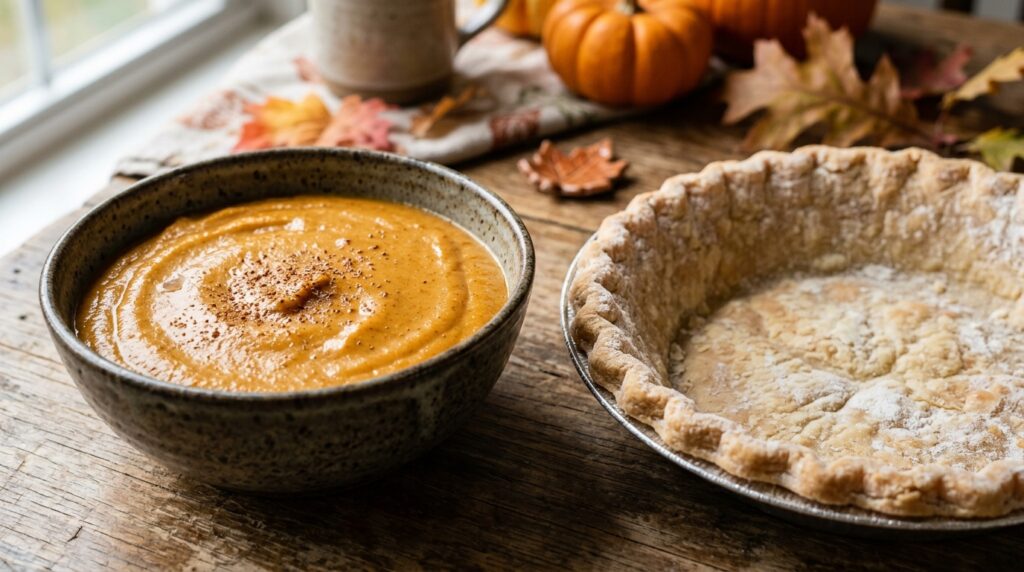
The five-ingredient filling
Gather one 15-ounce can of pumpkin puree, one 14-ounce can of sweetened condensed milk, and two large eggs. Add 1 tablespoon pumpkin pie spice and 1/4 teaspoon kosher salt.
The filling goes into a frozen, unbaked, 9-inch deep-dish pie shell. The shell should stay frozen until you are ready to add the mixed filling.
Put all five filling ingredients in one bowl and stir until combined. Stop when the mixture looks even, with no streaks of egg or dry spice left behind.
How this shortcut changes the formula
Sweetened condensed milk supplies sweetness and richness, so this recipe does not add separate sugar. That makes it a different pumpkin pie recipe condensed milk formula, not a shortcut swap for the classic version.
Pumpkin puree is plain pumpkin with no added sweetener or spice. Canned pumpkin pie filling already contains sugar and spices, so using it here would change the flavor and balance.
The short mixing time makes this a practical choice on a busy day. Keep the ingredient list and shell type together, then move to fresh pumpkin if you want to start with whole produce.
Can Fresh Pumpkin Work in These Recipes?
Fresh pumpkin can work, but its moisture and texture make it less predictable than canned puree. Fresh puree may need a longer bake, and the final pie may not match one made with canned pumpkin.
A sugar pie pumpkin is a suitable choice for homemade pumpkin puree. Lightly blot the puree if it seems wet, then follow an established filling formula rather than changing several ingredients at once.
Choosing and preparing fresh pumpkin puree
Choose a sugar pie pumpkin, which works well for puree used in pie. Cook the pumpkin until its flesh is soft, remove the skin, then mash or blend the flesh until smooth.
Fresh puree can hold more moisture than canned puree. If yours looks wet, blot it lightly with a clean towel to remove some excess moisture before measuring it for a filling.
Use the fresh puree in a tested recipe or an established adaptation. A recipe written for canned pumpkin may need a different bake time when fresh puree goes in.
Adjusting expectations when using fresh puree
In a direct recipe comparison, canned pumpkin produced a sturdier pie. The fresh version tasted grainier and more herbaceous, so the homemade pumpkin pie may have a more rustic texture.
Fresh puree can also need a longer bake than canned puree. Check the center for doneness rather than relying only on the clock, and do not assume the same texture will appear at the same time.
A pumpkin pie recipe with fresh pumpkin, sometimes called an old fashioned pumpkin pie recipe with fresh pumpkin, suits people who enjoy preparing produce from scratch. Once you decide on the filling, choose a crust method that helps protect the bottom.
How Can Caramel Pecans Change the Classic Slice?
A spoonful of warm caramel and pecans can turn a familiar slice into a more celebratory dessert. The topping adds brown sugar sweetness and crunch without changing the pumpkin filling.
Treat caramel pecans as an optional serving variation, not as a sixth filling recipe. Spoon the topping over cooled slices so it stays on top instead of mixing into the custard.
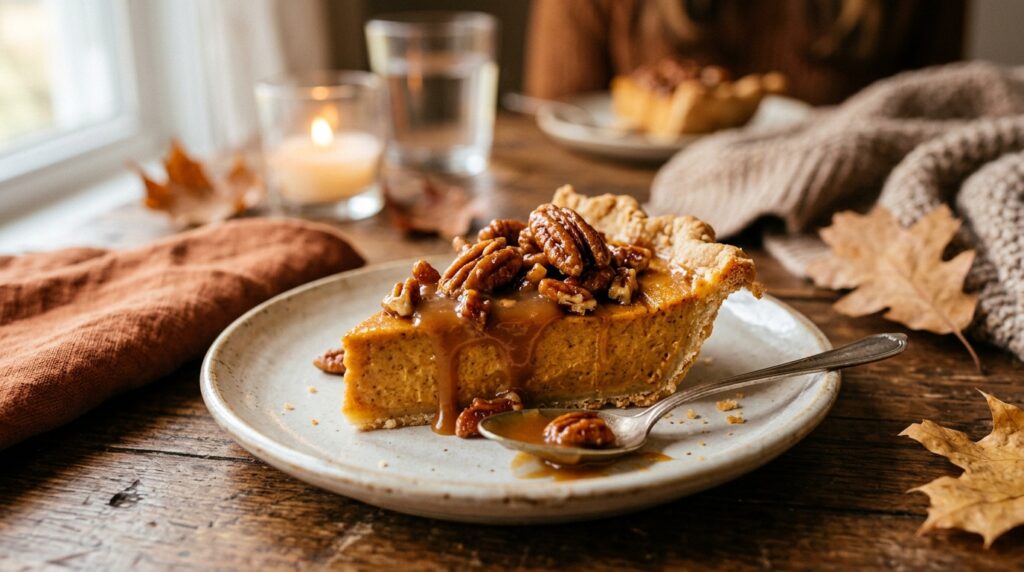
For the topping, measure 1/2 cup packed light brown sugar, 2 tablespoons heavy whipping cream, and 1 tablespoon light corn syrup. Add 1 tablespoon butter, 1/2 cup chopped pecans, and 1/2 teaspoon vanilla.
Place the brown sugar, cream, corn syrup, and butter in a small saucepan. Heat the mixture over medium heat, stirring until the butter melts and the sugar dissolves.
Let the sauce simmer for about 5 minutes, stirring often so it does not stick. Take the pan off the heat and stir in the pecans and vanilla.
The topping will thicken as it cools, so give it a moment before spooning it onto each serving. If it firms up more than you like, warm it gently until it loosens.
For another finishing touch, add whipped cream beside or over the slice. The sweet crunch works best when the pumpkin flavor remains the main part of each bite.
Because the topping goes on after baking, it lets you dress up a plain slice at serving time. Now shift from flavor choices to the crust treatment that keeps the base crisp.
Should I Prebake the Pie Crust?
Pumpkin fillings do not all need the same crust preparation. Follow the method written for your chosen recipe, because each filling was designed to bake with a specific shell.
Par-baking means briefly baking the crust before adding filling. It can help a shell set before it meets wet filling, but applying it to every pie can change the result.
When an unbaked shell works
The traditional evaporated-milk pie uses an unbaked 9-inch shell. It does not require blind baking before the filling goes in.
The condensed-milk version also starts with an unbaked shell, but it calls for a frozen, unbaked, 9-inch deep-dish pie shell. A homemade pie crust can work when it matches the size and shape the recipe expects.
When to par-bake the crust
The brown-sugar cream pie calls for a par-baked crust. Bake it for 10 minutes with pie weights, then remove the weights and bake the shell another 7-8 minutes.
Pie weights help hold the shell’s shape during that brief bake. The crust should be treated as directed before adding filling, rather than baked fully as if it were a finished empty shell.
| Recipe style | Crust starting condition | Crust preparation |
|---|---|---|
| Traditional evaporated-milk pie | Unbaked 9-inch shell | No blind baking |
| Brown-sugar cream pie | Unbaked pie crust | 10 minutes with weights, then 7-8 minutes without |
| Condensed-milk pie | Frozen, unbaked, 9-inch deep-dish shell | Use frozen and unbaked |
Crust thickness and pie dish shape can affect how a shell bakes, so match the recipe’s shell as closely as you can. A homemade pie crust does not need a new method simply because it is homemade.
The chosen recipe’s crust method matters more than using one method for every pie. Go to the bake schedules and doneness cues, where shell preparation and filling bake time come together.
How Do I Bake Each Pie Without Cracks?
A pumpkin pie is ready when its edges are set and its center still moves just a little. A slight wobble is normal, while a very jiggly center needs more time.
A clean knife test is another doneness cue, but avoid baking until the whole center feels firm. Overbaking and rushed cooling can both contribute to cracks.
A slight wobble is normal, while a very jiggly center needs more time. Overbaking and rushed cooling can both contribute to cracks.
The bake schedule for each filling
Use the schedule for the filling you chose, and place the pie as directed. The condensed-milk version bakes on a baking sheet with the oven rack in its lowest position.
| Recipe style | First oven setting and time | Reduced oven setting and time |
|---|---|---|
| Traditional evaporated-milk pie | 425°F for 15 minutes | 350°F for 40-50 minutes |
| Brown-sugar cream pie | 375°F for about 55-60 minutes | No reduced setting |
| Condensed-milk pie | 425°F for 15 minutes | 350°F for 35-40 minutes |
The brown-sugar cream recipe bakes at 375°F for about 55-60 minutes. Shield the crust edges after 25 minutes if they are browning too quickly.
The classic pie starts at 425°F for 15 minutes, then bakes at 350°F for 40-50 minutes. The condensed-milk pie starts the same way, then bakes at 350°F for 35-40 minutes.
Reading the center and cooling gently
Use these checks as the baking time nears its end:
- Look for set edges and a center that moves slightly.
- Give a very jiggly center more time in the oven.
- Use a clean knife test as another doneness cue.
- Shield browning crust edges when the recipe calls for it.
- Cool the pie undisturbed instead of moving or cutting it early.
- Take the pie out before the center becomes fully firm.
The center continues to set while the pie cools, so a small wobble is not a sign of failure. A clean knife gives another check, though the center should not be baked until rigid.
Let the pie cool without rushing it or shifting it around. Once it has cooled properly, decide how to make it ahead or keep the leftovers.
How Should I Cool, Store, and Freeze Pumpkin Pie?
Make-ahead timing is easiest when the pie style and storage limit are decided before baking day. Cool every pie completely before covering it, then refrigerate homemade pie if it has sat at room temperature for more than 2 hours.
Refrigerator and freezer limits vary by recipe, so use the matching row below. A whole pie can be made the day before, or you can prepare the crust and filling separately and refrigerate them.
| Pie style | Refrigerator storage | Freezer storage |
|---|---|---|
| Traditional evaporated-milk pie | 3-4 days | Up to 3 months |
| Brown-sugar cream pie | Up to 5 days | Up to 3 months |
| Condensed-milk pie | Up to 4 days | Up to 1 month |
For the best make-ahead plan, choose one of these approaches:
- Bake a whole pie the day before, then cool and refrigerate it.
- Prepare the crust and filling separately the day before, then chill both.
- Wrap leftover pie well before storing it in the refrigerator or freezer.
Thaw frozen pie overnight in the refrigerator before serving. Do not thaw it on the counter, where the center may warm before the rest of the pie.
These limits give you room to plan without guessing how long each version will keep. Choose the recipe that suits the flavor you want and the preparation time you have.
Conclusion
The best choice is the version that fits the ingredients and baking time you have. A dependable result starts with a formula suited to its milk and pumpkin puree, not a last-minute swap.
Gentle baking and cooling help the custard set without a dry center. Those small choices matter as much as the spice blend, especially when you want clean slices for guests.
Pick the recipe that matches your pantry and schedule, then set aside time to bake it without rushing the cool-down. I’d put your preferred formula on the next dessert menu and let that familiar aroma fill the kitchen.


